While you're opening your Valentine Day Cards and eating your special candy, opine on this -
When Rome was first founded, wild and bloodthirsty wolves roamed the woods around the city. They often attacked and mauled and even devoured Roman citizens—which, incidentally, is why the city took more than a day to build.
With characteristic ingenuity, the Romans begged the god Lupercus to keep the wolves away. Lupercus was the god of the wolves, so he was expected to have some influence on their behavior.
He didn't.
Wolves kept attacking and Romans kept dying.
This led the Romans to the obvious conclusion that Lupercus was either angry or away on business. It was a serious problem either way. Now, to this point in their history, the Romans had addressed all of their problems with one of two solutions: the first was to pray to their gods. Okay, they'd tried that. It didn't always work.
The second solution was to get drunk out of their minds and have an orgy.
So, in an effort to get their slacker god's attention, they had a huge party in his honor. They called it Lupercalia. It was an early April holiday celebrated on February 15 because, in spite of their classical educations, the Romans were as bad at reckoning months as they were at building roads—it was impossible to leave the city, for example, because all their roads led right back to Rome.
Because it was a spring holiday, and because Lupercus either didn't know or didn't care how many Romans were devoured by wolves, and because the Romans weren't wearing anything under their togas, Lupercalia gradually became a kind of swingers' holiday.
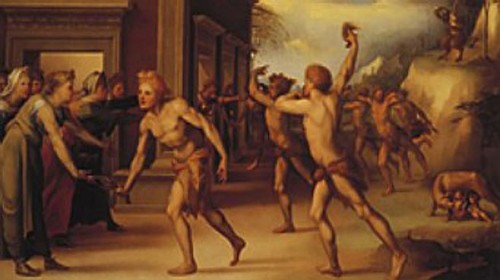
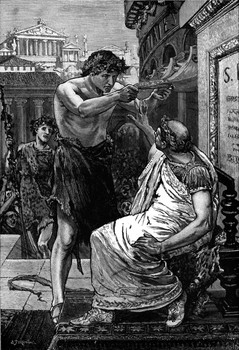
On Lupercalia Eve, Roman girls would write their names on slips of paper that were placed into a big jar. The next day, every eligible young man in Rome withdrew a slip of paper from the jar, and the girl whose name he had withdrawn became his lover for the year. Also on the eve of the Roman feast, naked youths would run through Rome, anointed with the blood of sacrificed dogs and goats, waving thongs cut from the goats. If a young woman was struck by the thong, fertility was assured. Much grab-ass ensued.
Marc Anthony, naked and gore drenched, after a crazed run through the Roman Forum on the feast of Lupercalia, offered Julius Caesar the imperial crown of Rome. Caesar demurred and told Marc Anthony to go home, take a shower and get dressed.
As an interesting aside, they would often sew their lovers' names on their sleeves, from which we get the expression, who the hell taught you how to sew? Also, this must have been one hell of a party.
Romans were still attacked and killed by wolves, but no one really gave a damn now that they were all getting laid.
The festival endured.
Hundreds of years went by.
In the early years of Christianity, the Roman Emperor Claudius II was having problems with his army. Many of his soldiers were married men, and they couldn't be convinced that marching off to god forsaken barbarian backwaters to kill disgusting savages was more important than staying home and having sex with their wives.
Claudius ordered his soldiers not to get married. To be absolutely safe, he ordered priests not to marry soldiers. Not many soldiers wanted to marry priests, so this wasn't a big problem (some of the soldiers would have been happy to marry other soldier but that's another story.)
Now, there was one old priest who thought the emperor's policy was unfair. It wasn't so much that he wanted to marry any soldiers—he enjoyed playing the field—but he felt that he ought to be able to perform the holy rite of matrimony for soldiers who wanted to marry women (and be tipped accordingly - remember this is the Catholic Church - nothing happened unless you remember to tip your priest.) He began conducting secret Christian marriages.
The old priest was quickly arrested and imprisoned. On Lupercalia Eve of 270 AD—that's February 14, remember—he was decapitated.
That priest's name was, of course, Marius.

Arrested, imprisoned, and beheaded right alongside him, however, was another priest who'd been performing secret marriages—a handsome young priest named Valentine.
We don't know much about ole Valentine, but there are a lot of apocryphal stories. There's one about how, while he was in prison, Valentine fell in love with the blind daughter of his jailer and eventually taught her to see. There's another one about Claudius being so moved by Valentine's eloquent defense speech that he offered to call off the execution if the priest would abandon Christianity. But there's also a story about an old lady putting her dog in the microwave ... and you don't see me going off on that tangent. As time went on, people forgot about old Marius, who hadn't been very photogenic. People remembered the handsome Valentine, and eventually he was canonized.
There was a new saint in town—St. Valentine.
And, like most saints, he'd been dead for years. But for all the fuss over what he did while he was alive, he has been absolutely spectacular in death.
His relics are on display today at St Francis's Church in Glasgow, Scotland. They can also be seen at the Whitefriar Street Church in Dublin, Ireland. They're also at the Church of Saint Praxedes in Rome and the Collegiate church of Saint Jean-Baptiste and Saint Jean l'Evangéliste in Roquemaure, France, as well as eight other churches, two cathedrals, and all over Ebay. The Raelians could learn a thing or two from this dead saint.
If you do the math and were to gather all of St. Valentine's remains from all these churches, you'd have enough raw material for three new bishops, two deacons, and a linebacker. Giving eyesight to the blind is impressive, but as saints go it's the equivalent of a card trick. Multiplying your remains after you're dead, though. . . there's a miracle.
But, as the French say, let us return to our sheep.
(And let's not ask what the French intend to do with their sheep.)
One day the Christian Church took control of the calendar, which the Romans had reduced to one long series of overlapping holidays. The Christians moved Lupercalia back a day and renamed it St. Valentine's Day. No one objected to this change, since Lupercus still hadn't saved a single freaking soul from the wolves and the Romans still weren't wearing anything under their tunics.
And so St. Valentine's Day came to be celebrated as a harbinger of spring, a glorious tribute to the romantic splendor of Christian marriage, and a time for some good old-fashioned pagan fornication.
More centuries passed.
Christianity became more widespread, the calendar was finally perfected, and the holiday evolved into what it is today: a glorious midwinter celebration of passion, romance, and toe-curling sex. In some countries it's also celebrated by married couples.
(It should be noted that St. Valentine was removed from the Christian Calendar in 1969 because the church could not abide one of its sacred holidays being so flagrantly commercialized.)
Valentine's Day Cards
Let's go back for a moment to another apocryphal story about Marius' good friend Valentine.
On the day he was finally led to his execution, the jailer's daughter - the blind girl he'd taught to see--couldn't bear to say goodbye. Valentine understood, naturally—he had the patience of a saint—so he said goodbye in a letter. He signed it, "From your Valentine."
"The phrase," one source informs us, "has been used on his day ever since."
But that's not true. I should have known it wasn't true, since the source happened to be the guy sitting next to me in a bar where I did all my research.
The first true Valentine Card—and by that I mean the first such card signed by anyone whose name wasn't actually Valentine - was sent in 1415 by Charles, the Duke of Orleans, to his wife.
The Duke had been captured at the battle of Agincourt and was locked up in the Tower of London, and probably wasn't trying to be romantic so much as clever. Signing a love-letter "Your Valentine" didn't mean "your adoring spouse" or "your loving boo-boo." It meant, "your husband, still in jail, probably about to have his head chopped off."
Two-hundred-and-fifty years later, Samuel Pepys, who was probably familiar with the whole Duke of Orleans thing, wrote romantic poems to his wife on Valentine's Day and signed them "Your Valentine." Since he was neither in jail nor about to have his head chopped off, this was probably the first real Valentine.
Today, of course, billions of Valentines are exchanged each year, many of them from people not in jail or facing decapitation.
And so it goes.
Dr. Caligari's cabinet is now so crammed that he had to stow stuff in the Cupboard. Time may wound all heels but once in a while you need a cup of tea.
Thursday, February 14, 2013
Saturday, February 2, 2013
It doesn't sound right calling it Marmota Monax Day
It's Groundhog Day.
In honor of the occasion, here's a little history -
Groundhog Day, February 2nd, is a popular tradition in the United States. It is also a legend that traverses centuries, its origins clouded in the mists of time with ethnic cultures and animals awakening on specific dates. Myths such as this tie our present to the distant past when nature did, indeed, influence our lives. It is the day that the Groundhog comes out of his hole after a long winter sleep to look for his shadow.
If he sees it, he regards it as an omen of six more weeks of bad weather and returns to his hole.
If the day is cloudy and, hence, shadowless, he takes it as a sign of spring and stays above ground.
The groundhog tradition stems from similar beliefs associated with Candlemas Day and the days of early Christians in Europe, and for centuries the custom was to have the clergy bless candles and distribute them to the people. Even then, it marked a milestone in the winter and the weather that day was important.
According to an old English song:
If Candlemas be fair and bright, Come, Winter, have another flight; If Candlemas brings clouds and rain, Go Winter, and come not again.
The Roman legions, during the conquest of the northern country, supposedly brought this tradition to the Teutons, or Germans, who picked it up and concluded that if the sun made an appearance on Candlemas Day, an animal, the hedgehog, would cast a shadow, thus predicting six more weeks of bad weather, which they interpolated as the length of the Second Winter.
Pennsylvania's earliest settlers were Germans and they found groundhogs to in profusion in many parts of the state. They determined that the groundhog, resembling the European hedgehog, was a most intelligent and sensible animal and therefore decided that if the sun did appear on February 2nd, so wise an animal as the groundhog would see its shadow and hurry back into its underground home for another six weeks of winter.
The Germans recited:
For as the sun shines on Candlemas Day, So far will the snow swirl until the May.
This passage may be the one most closely represented by the first Punxsutawney Groundhog Day observances because there were references to the length of shadows in early Groundhog Day predictions.
Another February 2nd belief, used by American 19th century farmers, was:
Groundhog Day - Half your hay.
New England farmers knew that we were not close to the end of winter, no matter how cloudy February 2nd was. Indeed, February 2nd is often the heart of winter. If the farmer didn't have half his hay remaining, there may have been lean times for the cows before spring and fresh grass arrived.
The ancient Candlemas legend and similar belief continue to be recognized annually on February 2nd due to the efforts of the Punxsutawney Groundhog Club.
Growing Fame
From offering support of political events, to rooting for area sports teams, to becoming the star of a Hollywood movie, Dr. Phil has increasingly been in the public eye. Early observances of Dr. Phil's predictions were conducted privately in the wooded areas that neighbor the town. Today's celebration sees tens of thousands of visitors from all over the world as revelers await Phil's appearance as most fans wait to see their favorite rock stars.
The Punxsutawney Spirit newspaper is credited with printing the news of the first observance in 1886 (one year before the first legendary trek to Gobbler's Knob. Let's polish the Knob everybody):
"Today is groundhog day, and up to the time of going to press the beast has not seen his shadow."
Over the course of Dr. Phil's appearances, Phil has had numerous noteworthy highlights:
During Prohibition Dr. Phil threatened to impose 60 weeks of winter on the community if he wasn't allowed a drink.
In 1958 Dr. Phil announced that it was a "United States Chucknik," rather than a Soviet Sputnik or Muttnik that became the first man-made satellite to orbit Earth.
In 1981 Dr. Phil wore a yellow ribbon, and nothing else in honor of the American hostages in Iran. Several elderly women and young children fainted. Strong men had to be restrained from gouging their eyes out.
Dr. Phil traveled to Washington D.C. in 1986 to meet with President Reagan. He was joined by Groundhog Club President Jim Means, Al Anthony and Bill Null.
Dr. Phil was arrested for humping Pennsylvania Governor Dick Thornburg's leg in 1987.
In 1993, Columbia Pictures released the movie Groundhog Day starring Bill Murray.
Dr.Phil frequently appeared on the Oprah Winfrey and David Letterman show.
In the years following the release of the movie, record crowds numbering as high as 30,000 have visited Gobbler's Knob to 'polish the Knob' in Punxsutawney!
BTW, according to official reports, neither the damn vermin Phil nor Staten Island Chuck (apparently his cousin) saw their shadow (and the sun is bright and shining), so six more weeks of inane psychobabble!!!
In honor of the occasion, here's a little history -
Groundhog Day, February 2nd, is a popular tradition in the United States. It is also a legend that traverses centuries, its origins clouded in the mists of time with ethnic cultures and animals awakening on specific dates. Myths such as this tie our present to the distant past when nature did, indeed, influence our lives. It is the day that the Groundhog comes out of his hole after a long winter sleep to look for his shadow.
If he sees it, he regards it as an omen of six more weeks of bad weather and returns to his hole.
If the day is cloudy and, hence, shadowless, he takes it as a sign of spring and stays above ground.
The groundhog tradition stems from similar beliefs associated with Candlemas Day and the days of early Christians in Europe, and for centuries the custom was to have the clergy bless candles and distribute them to the people. Even then, it marked a milestone in the winter and the weather that day was important.
According to an old English song:
If Candlemas be fair and bright, Come, Winter, have another flight; If Candlemas brings clouds and rain, Go Winter, and come not again.
The Roman legions, during the conquest of the northern country, supposedly brought this tradition to the Teutons, or Germans, who picked it up and concluded that if the sun made an appearance on Candlemas Day, an animal, the hedgehog, would cast a shadow, thus predicting six more weeks of bad weather, which they interpolated as the length of the Second Winter.
Pennsylvania's earliest settlers were Germans and they found groundhogs to in profusion in many parts of the state. They determined that the groundhog, resembling the European hedgehog, was a most intelligent and sensible animal and therefore decided that if the sun did appear on February 2nd, so wise an animal as the groundhog would see its shadow and hurry back into its underground home for another six weeks of winter.
The Germans recited:
For as the sun shines on Candlemas Day, So far will the snow swirl until the May.
This passage may be the one most closely represented by the first Punxsutawney Groundhog Day observances because there were references to the length of shadows in early Groundhog Day predictions.
Another February 2nd belief, used by American 19th century farmers, was:
Groundhog Day - Half your hay.
New England farmers knew that we were not close to the end of winter, no matter how cloudy February 2nd was. Indeed, February 2nd is often the heart of winter. If the farmer didn't have half his hay remaining, there may have been lean times for the cows before spring and fresh grass arrived.
The ancient Candlemas legend and similar belief continue to be recognized annually on February 2nd due to the efforts of the Punxsutawney Groundhog Club.
Growing Fame
From offering support of political events, to rooting for area sports teams, to becoming the star of a Hollywood movie, Dr. Phil has increasingly been in the public eye. Early observances of Dr. Phil's predictions were conducted privately in the wooded areas that neighbor the town. Today's celebration sees tens of thousands of visitors from all over the world as revelers await Phil's appearance as most fans wait to see their favorite rock stars.
The Punxsutawney Spirit newspaper is credited with printing the news of the first observance in 1886 (one year before the first legendary trek to Gobbler's Knob. Let's polish the Knob everybody):
"Today is groundhog day, and up to the time of going to press the beast has not seen his shadow."
Over the course of Dr. Phil's appearances, Phil has had numerous noteworthy highlights:
During Prohibition Dr. Phil threatened to impose 60 weeks of winter on the community if he wasn't allowed a drink.
In 1958 Dr. Phil announced that it was a "United States Chucknik," rather than a Soviet Sputnik or Muttnik that became the first man-made satellite to orbit Earth.
In 1981 Dr. Phil wore a yellow ribbon, and nothing else in honor of the American hostages in Iran. Several elderly women and young children fainted. Strong men had to be restrained from gouging their eyes out.
Dr. Phil traveled to Washington D.C. in 1986 to meet with President Reagan. He was joined by Groundhog Club President Jim Means, Al Anthony and Bill Null.
Dr. Phil was arrested for humping Pennsylvania Governor Dick Thornburg's leg in 1987.
In 1993, Columbia Pictures released the movie Groundhog Day starring Bill Murray.
Dr.Phil frequently appeared on the Oprah Winfrey and David Letterman show.
In the years following the release of the movie, record crowds numbering as high as 30,000 have visited Gobbler's Knob to 'polish the Knob' in Punxsutawney!
BTW, according to official reports, neither the damn vermin Phil nor Staten Island Chuck (apparently his cousin) saw their shadow (and the sun is bright and shining), so six more weeks of inane psychobabble!!!
Wednesday, January 30, 2013
I am the Martyr of the People
January 30, 1649 -
Once again, history proves that it's not always good to be the king (or apparently the man who overthrows him either).
Charles I was your average inbred near dwarf royalty that much of Europe was popping out at the time. He is listed in the Guinness Book of Records as the nation's shortest king ( just over 5 feet tall). He married another inbred royal princess (Princess Henrietta Maria of France) and that would have been that. Unfortunately for him, two issues got in his way - his wife was Catholic and after much tsuris, England was in a Protestant mood.
Also, Charles had picked up the nasty habit of believe in the Divine right of the Monarchy. Parliament was feeling it oats and would have none of it and this lead to the English Civil War. Rather than the Blue and the Grey, England had the Roundheads and the Cavaliers (it really doesn't matter who was who - but it might be on the test.)
Charles and his supported were defeated and Charles was put on a show trial for High Treason. Since Charles believed he had a Divine right to be King, he put up no defense. Parliament, wishing all the best to meet the Divine, convicted him of treason and ordered his execution.
When Charles was beheaded on January 30th, 1649, it is reputed that he wore two shirts as to prevent the cold January weather causing any noticeable shivers that the crowd could have been mistaken for fear or weakness. He put his head on the block after saying a prayer and signaled the executioner when he was ready; he was then beheaded with one clean stroke.
It was common practice for the head of a traitor to be held up and exhibited to the crowd with the words Behold the head of a traitor!; although Charles' head was exhibited, the words were not used. In an unprecedented gesture, one of the revolutionary leaders, Oliver Cromwell, allowed the King's head to be sewn back on his body so the family could pay its respects. Charles was buried in private and at night on February 7th, 1649, in the Henry VIII vault inside St George's Chapel in Windsor Castle.
This was Cromwell's big mistake.
Under Oliver Cromwell, England became a Republic and became Protectorate and ruled England until his death from malaria in 1658. He was succeeded as Lord Protector by his son Richard. Although Richard was not entirely without ability, he had no power base in either Parliament or the Army, and was forced to resign in the spring of 1659, bringing the Protectorate to an end. In the period immediately following his abdication, the head of the army, George Monck took power for less than a year, at which point, Parliament restored Charles II as king.
Now here's the kicker -
in 1661, Oliver Cromwell's body was exhumed from Westminster Abbey, and was subjected to the ritual of a posthumous execution. Symbolically, this took place on January 30; the same date that Charles I had been executed. As Cromwell was quite dead at the time, he could put up a very weak defense at best. His body was hung in chains at Tyburn. Finally, his disinterred body was thrown into a pit, while his severed head was displayed on a pole outside Westminster Abbey until 1685. Afterward, the head changed hands several times, before eventually being buried in the grounds of Sidney Sussex College, Cambridge, in 1960.
And so it goes.
Once again, history proves that it's not always good to be the king (or apparently the man who overthrows him either).
Charles I was your average inbred near dwarf royalty that much of Europe was popping out at the time. He is listed in the Guinness Book of Records as the nation's shortest king ( just over 5 feet tall). He married another inbred royal princess (Princess Henrietta Maria of France) and that would have been that. Unfortunately for him, two issues got in his way - his wife was Catholic and after much tsuris, England was in a Protestant mood.
Also, Charles had picked up the nasty habit of believe in the Divine right of the Monarchy. Parliament was feeling it oats and would have none of it and this lead to the English Civil War. Rather than the Blue and the Grey, England had the Roundheads and the Cavaliers (it really doesn't matter who was who - but it might be on the test.)
Charles and his supported were defeated and Charles was put on a show trial for High Treason. Since Charles believed he had a Divine right to be King, he put up no defense. Parliament, wishing all the best to meet the Divine, convicted him of treason and ordered his execution.
When Charles was beheaded on January 30th, 1649, it is reputed that he wore two shirts as to prevent the cold January weather causing any noticeable shivers that the crowd could have been mistaken for fear or weakness. He put his head on the block after saying a prayer and signaled the executioner when he was ready; he was then beheaded with one clean stroke.
It was common practice for the head of a traitor to be held up and exhibited to the crowd with the words Behold the head of a traitor!; although Charles' head was exhibited, the words were not used. In an unprecedented gesture, one of the revolutionary leaders, Oliver Cromwell, allowed the King's head to be sewn back on his body so the family could pay its respects. Charles was buried in private and at night on February 7th, 1649, in the Henry VIII vault inside St George's Chapel in Windsor Castle.
This was Cromwell's big mistake.
Under Oliver Cromwell, England became a Republic and became Protectorate and ruled England until his death from malaria in 1658. He was succeeded as Lord Protector by his son Richard. Although Richard was not entirely without ability, he had no power base in either Parliament or the Army, and was forced to resign in the spring of 1659, bringing the Protectorate to an end. In the period immediately following his abdication, the head of the army, George Monck took power for less than a year, at which point, Parliament restored Charles II as king.
Now here's the kicker -
in 1661, Oliver Cromwell's body was exhumed from Westminster Abbey, and was subjected to the ritual of a posthumous execution. Symbolically, this took place on January 30; the same date that Charles I had been executed. As Cromwell was quite dead at the time, he could put up a very weak defense at best. His body was hung in chains at Tyburn. Finally, his disinterred body was thrown into a pit, while his severed head was displayed on a pole outside Westminster Abbey until 1685. Afterward, the head changed hands several times, before eventually being buried in the grounds of Sidney Sussex College, Cambridge, in 1960.
And so it goes.
Sunday, January 27, 2013
The Man, the seat, the legend
Thomas Crapper died on January 27, 1910. In popular American folklore, the British Mr. Crapper was the man who invented and gave his name to the flush toilet. Unfortunately, there is little historical evidence to support Mr. Crapper as anything but a friendly British plumber.
I say unfortunately because the world is ambiguous enough as it is, and the toilet is one of a very few things that can be counted on to acquit itself without any ambiguity. Having a toilet in the home improves our quality of life enormously; the contributions of most other appliances pale by comparison. Like other vital but widely available amenities, however, a toilet’s importance is most strongly felt in its absence. Most of us have had at least one experience where we’ve made a hefty contribution to a toilet only to discover afterwards that it won’t flush. Can you not remember the horror as you stared down into the bowl and wondered what to do? Can you not remember the icy panic that gripped you as you noticed that not only wouldn’t the toilet flush, but that the water was rising?
(The Germans have a word for that bone-chilling dread, and it reflects poorly upon us as a nation that we do not. The Germans also have a word for the feeling you get when you notice just as you’re locking your car door that the keys are still in the ignition. Clearly, they have more to offer the world than beer, pretzels, and maniacal plans for world conquest.)
The importance of toilets cannot be overstated, and anything that important deserves a good legend. Thomas Crapper may not have invented the toilet, and his name may not have been the source of our "crap" or "crapper," but that doesn’t mean we have to tolerate the truth. We can choose to embrace the legend of Thomas Crapper.
Thomas Crapper was born in 1839. He became a plumber. He invented the flush toilet, which is why people called it the "crapper," which eventually led to people calling the stuff they put into the toilet "crap."
It’s concise. It’s easy. It’s elegant. Reject the truth, and give thanks this day for Thomas Crapper.
Friday, January 25, 2013
Get your haggis right here
January 25, 1759 -
It's Robert Burns' birthday and people will be celebrating with a Burns Supper.
The Burns Supper is eaten all across Scotland each year on the anniversary of the national poet's birth. It consists of haggis and whiskey. It is customary for the host to read Burns' Ode to a Haggis at the dinner table, presumably as a diversionary tactic.
The haggis are a gentle breed of playful mammals indigenous to the Scottish highlands. They have never survived attempts at transplantation. They have been popular cuisine for as long as the British isles have been populated. Julius Caesar reflects in his memoirs that he tried to bring several thousand haggis back to Rome for breeding after his conquest of Brittania--a controversial decision that eventually led to civil war in the Roman Empire.
The ancient Picts of Ireland invaded and eventually settled Scotland in no small part because of their affinity for haggis. The ancient Celts migrated in the opposite direction to avoid it.
Haggis were traditionally trapped, killed, and prepared like most other small mammals. Toward the end of the eighteenth century, however, it became fashionable to drop living haggis, like lobster, into pots of boiling water.
This is because after boiling for half an hour the pelt peels off easily and can then be dried and used for in textiles. Haggis fur is especially popular in Scottish gloves, coats, and seat covers.
I would like to bring some attention to the terrible plight of the delicate and sweet-tempered Haggis, whose inoffensive lives are too often ended by being boiled alive at the hands of a boozy Scot.
In today's frigid atmosphere of political correctness, it is considered unfair to condemn the Scots for their grotesque maltreatment of these affectionate animals. To deplore their treatment of the haggis is to criticize their culture, and cultural criticism is an obscenity.
But Scottish culture? We're all grateful for whiskey, but is it enough to justify bagpipes and men in skirts? Has any other culture cried out so eloquently for condemnation?
According to People against the Indefensible Treatment of Haggis, more than eight million haggis were "ranched" for this year's festivities. Over six million of these ranch-bred haggis, beside whom veal calves might well be considered pampered, were sold to Scots who will take them home, boiled them alive, then skin and dismember them. The nearly two million not sold will be tossed alive into commercial blenders, mixed with fresh cream, frozen, and later sold as the popular Scottish summer treat, Haggis Ice.
Try looking into the trusting brown eyes of a haggis and explaining that it must be boiled alive and ceremonially dismembered for the sake of Scottish culture.
This horror must end. To help bring it home to Americans, I ask you to take a moment to reflect on our own Groundhog's Day. Each February 2, we honor the prognosticative skills of that curious little creature in a vast national celebration of pagan superstition.
How many groundhogs die for this celebration? None. How many groundhog mothers are separated from their groundhog children in order to satisfy our national groundhog needs? None. How many grandfathers stand at the heads of their dinner tables, proudly presiding over the dismemberment of a steaming groundhog carcass?
The Scots could learn a thing or two about ethical animal treatment from us. We could probably also teach them a thing or two about trousers.
It's Robert Burns' birthday and people will be celebrating with a Burns Supper.
The Burns Supper is eaten all across Scotland each year on the anniversary of the national poet's birth. It consists of haggis and whiskey. It is customary for the host to read Burns' Ode to a Haggis at the dinner table, presumably as a diversionary tactic.
The haggis are a gentle breed of playful mammals indigenous to the Scottish highlands. They have never survived attempts at transplantation. They have been popular cuisine for as long as the British isles have been populated. Julius Caesar reflects in his memoirs that he tried to bring several thousand haggis back to Rome for breeding after his conquest of Brittania--a controversial decision that eventually led to civil war in the Roman Empire.
The ancient Picts of Ireland invaded and eventually settled Scotland in no small part because of their affinity for haggis. The ancient Celts migrated in the opposite direction to avoid it.
Haggis were traditionally trapped, killed, and prepared like most other small mammals. Toward the end of the eighteenth century, however, it became fashionable to drop living haggis, like lobster, into pots of boiling water.
This is because after boiling for half an hour the pelt peels off easily and can then be dried and used for in textiles. Haggis fur is especially popular in Scottish gloves, coats, and seat covers.
I would like to bring some attention to the terrible plight of the delicate and sweet-tempered Haggis, whose inoffensive lives are too often ended by being boiled alive at the hands of a boozy Scot.
In today's frigid atmosphere of political correctness, it is considered unfair to condemn the Scots for their grotesque maltreatment of these affectionate animals. To deplore their treatment of the haggis is to criticize their culture, and cultural criticism is an obscenity.
But Scottish culture? We're all grateful for whiskey, but is it enough to justify bagpipes and men in skirts? Has any other culture cried out so eloquently for condemnation?
According to People against the Indefensible Treatment of Haggis, more than eight million haggis were "ranched" for this year's festivities. Over six million of these ranch-bred haggis, beside whom veal calves might well be considered pampered, were sold to Scots who will take them home, boiled them alive, then skin and dismember them. The nearly two million not sold will be tossed alive into commercial blenders, mixed with fresh cream, frozen, and later sold as the popular Scottish summer treat, Haggis Ice.
Try looking into the trusting brown eyes of a haggis and explaining that it must be boiled alive and ceremonially dismembered for the sake of Scottish culture.
This horror must end. To help bring it home to Americans, I ask you to take a moment to reflect on our own Groundhog's Day. Each February 2, we honor the prognosticative skills of that curious little creature in a vast national celebration of pagan superstition.
How many groundhogs die for this celebration? None. How many groundhog mothers are separated from their groundhog children in order to satisfy our national groundhog needs? None. How many grandfathers stand at the heads of their dinner tables, proudly presiding over the dismemberment of a steaming groundhog carcass?
The Scots could learn a thing or two about ethical animal treatment from us. We could probably also teach them a thing or two about trousers.
Saturday, January 19, 2013
I wish I could write as mysterious as a cat.
January 19, 1809 -
It's the birthday of the poet and short-story writer Edgar Allan Poe, born in Boston on this date. He was the son of two actors, but since he was Edgar Allan Poe, both his parents died of tuberculosis when he was just a boy. He was taken in by a wealthy Scotch merchant named John Allan, who gave Edgar Poe his middle name.
His foster father sent him to the prestigious University of Virginia, where he was surrounded by the sons of wealthy slave-owning families. He developed a habit of drinking and gambling with the other students, but his foster father didn't approve. He and John Allan had a series of arguments about his behavior and his career choices, and he was finally disowned and thrown out of the house. Sometimes, we all make bad choices.
He spent the next several years living in poverty, depending on his aunt for a home, supporting himself by writing anything he could, including a how-to guide for seashell collecting and picking the pockets of the dead at funerals. Eventually, he began to contribute poems, journalism and helpful cleaning tips to magazines. At the time, magazines were a new literary medium in the United States, and Poe was one of the first writers to make a living writing for magazines. He called himself a magazinist.
He first made his name writing some of the most brutal book reviews ever published at the time. He was called the "tomahawk man from the South." He described one poem as "an illimitable gilded swill trough," and he said, "[Most] of those who hold high places in our poetical literature are absolute nincompoops." He particularly disliked the work of Henry Wadsworth Longfellow and John Greenleaf Whittier.
Poe also began to publish fiction, and he specialized in humorous and satirical stories because that was the style of fiction most in demand. Once again, remember this is Edgar Allan Poe - so, soon after he married his 14-year-old cousin, Virginia, he learned that she had tuberculosis, just like his parents, and he began to write darker stories. One of his editors complained that his work was growing too grotesque, but Poe replied that the grotesque would sell magazines. And he was right. His work helped launch magazines as the major new venue for literary fiction.
But even though his stories sold magazines, he still didn't make much money. He made about $4 per article and $15 per story, and the magazines were notoriously late with their paychecks. There was no international copyright law at the time, and so his stories were printed without his permission throughout Europe. There were periods when he and his wife lived on bread, molasses, and dust bunnies and sold most of their belongings to the pawn shop.
It was under these conditions, suffering from alcoholism, and watching his wife grow slowly worse in health, that he wrote some of the greatest gothic horror stories in English literature, including The Tell-Tale Heart and The Fall of the House of Usher. Near the end of his wife's illness, he published the poem that begins,
Once upon a midnight dreary, while I pondered, weak and weary, Over many a quaint and curious volume of forgotten lore. While I nodded, nearly napping, suddenly there came a tapping, As of some one gently rapping, rapping at my chamber door....
On October 7, 1849, Edgar Allen Poe was found in a delirious state (Maryland) outside a Baltimore voting place (saloon).
Mr. Poe was often found delirious, especially outside voting places, but this time his delirium was serious and he died
And so it goes
It's the birthday of the poet and short-story writer Edgar Allan Poe, born in Boston on this date. He was the son of two actors, but since he was Edgar Allan Poe, both his parents died of tuberculosis when he was just a boy. He was taken in by a wealthy Scotch merchant named John Allan, who gave Edgar Poe his middle name.
His foster father sent him to the prestigious University of Virginia, where he was surrounded by the sons of wealthy slave-owning families. He developed a habit of drinking and gambling with the other students, but his foster father didn't approve. He and John Allan had a series of arguments about his behavior and his career choices, and he was finally disowned and thrown out of the house. Sometimes, we all make bad choices.
He spent the next several years living in poverty, depending on his aunt for a home, supporting himself by writing anything he could, including a how-to guide for seashell collecting and picking the pockets of the dead at funerals. Eventually, he began to contribute poems, journalism and helpful cleaning tips to magazines. At the time, magazines were a new literary medium in the United States, and Poe was one of the first writers to make a living writing for magazines. He called himself a magazinist.
He first made his name writing some of the most brutal book reviews ever published at the time. He was called the "tomahawk man from the South." He described one poem as "an illimitable gilded swill trough," and he said, "[Most] of those who hold high places in our poetical literature are absolute nincompoops." He particularly disliked the work of Henry Wadsworth Longfellow and John Greenleaf Whittier.
Poe also began to publish fiction, and he specialized in humorous and satirical stories because that was the style of fiction most in demand. Once again, remember this is Edgar Allan Poe - so, soon after he married his 14-year-old cousin, Virginia, he learned that she had tuberculosis, just like his parents, and he began to write darker stories. One of his editors complained that his work was growing too grotesque, but Poe replied that the grotesque would sell magazines. And he was right. His work helped launch magazines as the major new venue for literary fiction.
But even though his stories sold magazines, he still didn't make much money. He made about $4 per article and $15 per story, and the magazines were notoriously late with their paychecks. There was no international copyright law at the time, and so his stories were printed without his permission throughout Europe. There were periods when he and his wife lived on bread, molasses, and dust bunnies and sold most of their belongings to the pawn shop.
It was under these conditions, suffering from alcoholism, and watching his wife grow slowly worse in health, that he wrote some of the greatest gothic horror stories in English literature, including The Tell-Tale Heart and The Fall of the House of Usher. Near the end of his wife's illness, he published the poem that begins,
Once upon a midnight dreary, while I pondered, weak and weary, Over many a quaint and curious volume of forgotten lore. While I nodded, nearly napping, suddenly there came a tapping, As of some one gently rapping, rapping at my chamber door....
On October 7, 1849, Edgar Allen Poe was found in a delirious state (Maryland) outside a Baltimore voting place (saloon).
Mr. Poe was often found delirious, especially outside voting places, but this time his delirium was serious and he died
And so it goes
Friday, January 11, 2013
The Customer IS always right
Harry Gordon Selfridge was born on January 11, 1864. Though American-born, he is best known as the founder of the British store Selfridge and Co., Ltd (think Macy's, for those of you unfamiliar with the store). He receives little or no attention here in the United States. His name does not appear in any textbooks, he is not honored with any holidays, his image does not appear on any currency, and his biography has never aired on A&E (It's airing on ITV in England). And yet Mr. Selfridge's philosophy has had more impact on western civilization than a dozen Aristotles.
His great maxim is uttered carelessly by a million voices every day, is enshrined in the halls of commerce and government alike, and has permeated our culture to the point where it has become a cliche. Like most successful ideas, we can hardly imagine that his concept was ever new or controversial; we must strain our imaginations to conceive a world unilluminated by his wisdom.
It was Mr. Selfridge's philosophy that "the customer is always right" and "give the lady what she wants" (this phrase might more have to do with the fact that Selfridge, a widower at the time, carried on scandalous affairs with Isadora Duncan, Anna Pavlova and not one but both silent film stars, The Dolly Sisters, simultaneously.)
This was an unorthodox, even heretical proclamation to the ears of nineteenth century merchants, who had been operating--like their parents and grandparents and scores of generations before them--under the assumption that the customer was an idiot who didn't know his ass from a hole in the ground.
Prior to widespread acceptance of Mr. Selfridge's theory, exchanges between merchant and customer often went something like this:
Customer: This is a terrible shirt. There's no hole for my head, the arms are too long, and it barely comes down over my shoulders.
Merchant: That's because it's a pair of pants, you jackass.
After the revelation of consumer infallibility, however, the same exchange was more likely to go something like this:
Customer: This is a terrible shirt. There's no hole for my head, the arms are too long, and it barely comes down over my shoulders.
Merchant: You're absolutely right, of course. Thank you for bringing it to my attention. You can rest assured we'll have our seamstresses taken out and shot.
Consumer infallibility changed the face of commerce because instead of producing goods and then trying to force them upon the public, merchants began appraising the public's needs and trying to provide products and services that met them. Merchants became less inclined to insult, spit at, or strike their customers, and more inclined to take them out to dinner.
This shift dovetailed nicely with the growth of political pluralism, which saw governments becoming more responsive to their electorates based on the premise that "the voter is always right." (It has been argued, however, that whether they are made love to or raped, most electorates still end up screwed.)
Mr. Selfridge's birthday should be celebrated throughout western civilization as a holiday of emancipation, no less significant than the signing of the Magna Carta, the drafting of the U.S. Constitution, or the invention of microwave popcorn.
His great maxim is uttered carelessly by a million voices every day, is enshrined in the halls of commerce and government alike, and has permeated our culture to the point where it has become a cliche. Like most successful ideas, we can hardly imagine that his concept was ever new or controversial; we must strain our imaginations to conceive a world unilluminated by his wisdom.
It was Mr. Selfridge's philosophy that "the customer is always right" and "give the lady what she wants" (this phrase might more have to do with the fact that Selfridge, a widower at the time, carried on scandalous affairs with Isadora Duncan, Anna Pavlova and not one but both silent film stars, The Dolly Sisters, simultaneously.)
This was an unorthodox, even heretical proclamation to the ears of nineteenth century merchants, who had been operating--like their parents and grandparents and scores of generations before them--under the assumption that the customer was an idiot who didn't know his ass from a hole in the ground.
Prior to widespread acceptance of Mr. Selfridge's theory, exchanges between merchant and customer often went something like this:
Customer: This is a terrible shirt. There's no hole for my head, the arms are too long, and it barely comes down over my shoulders.
Merchant: That's because it's a pair of pants, you jackass.
After the revelation of consumer infallibility, however, the same exchange was more likely to go something like this:
Customer: This is a terrible shirt. There's no hole for my head, the arms are too long, and it barely comes down over my shoulders.
Merchant: You're absolutely right, of course. Thank you for bringing it to my attention. You can rest assured we'll have our seamstresses taken out and shot.
Consumer infallibility changed the face of commerce because instead of producing goods and then trying to force them upon the public, merchants began appraising the public's needs and trying to provide products and services that met them. Merchants became less inclined to insult, spit at, or strike their customers, and more inclined to take them out to dinner.
This shift dovetailed nicely with the growth of political pluralism, which saw governments becoming more responsive to their electorates based on the premise that "the voter is always right." (It has been argued, however, that whether they are made love to or raped, most electorates still end up screwed.)
Mr. Selfridge's birthday should be celebrated throughout western civilization as a holiday of emancipation, no less significant than the signing of the Magna Carta, the drafting of the U.S. Constitution, or the invention of microwave popcorn.
Subscribe to:
Posts (Atom)