Dr. Caligari's cabinet is now so crammed that he had to stow stuff in the Cupboard. Time may wound all heels but once in a while you need a cup of tea.
Buckaroo Bugs 1944 Looney Tune title, directed by Bob Clampett. This was the last cartoon release to bear Leon Schlesinger's name, as he sold his cartoon studio to Warner Bros. around the time of its release.
This is the only short in which Bugs Bunny served as a bona fide villain; while his shorts often portray him as mischievous and violent, he is never actually malicious and is, for the most part, acting as such in self-defense against an aggressor.
History is a peculiar concept. Children are taught to memorize certain dates as touchstones to change: 1492; July 4, 1776; November 11, 1918; July 6, 1957; July 16, 1969. July 6, 1957?The ACME Eagle Hand Soap Radio Hour would like to celebrate the anniversary of a 15-year old Paul McCartney meeting a 16-year old John Lennon at the St Peter's Church fair, where John's skiffle band, the Quarrymen were performing. Quite literally, the world as we know it changed after that meeting. Today we would like you to join us in watching the Beatle's 1964 movie, A Hard's Day Night, which happened to premiere in London on this date in 1964. So we would like you to find the most comfortable seat on the sofa, get a snack and a beverage and join The ACME Eagle Hand Soap Radio Hour in watching the first feature the Beatles appeared in - A Hard's Day Night.
After filming for the day on April 1st 1964, John Lennon had met his father, Alfred Lennon, for the first time in 17 years. In the morning Alf had walked into NEMS Enterprises (where The Beatles' manager Brian Epstein worked) accompanied by a journalist. After explaining to the receptionist that he was John's father, and when Epstein was informed he immediately sent for a car to pick up John, the rest of The Beatles with the exception of Paul McCartney tagging along, bringing them over to NEMS. The meeting was unsuccessful, however; the first words John said to his father were, "What do you want?" The meeting lasted no longer than 20 minutes, and ended up with a furious John ordering Alf off the premises. The encounter was kept out of newspapers by trading with the journalist for exclusive stories about the other bands Epstein managed.
(As has been our usual want for many a year, Mrs. Dr. Caligari, SOS, Godzilla and I are laying on a beach with our mispukah. Our internet
connection is spotty, so I have attempted to post this a few days ago.)
(This photo was taken by by CIA operatives several years ago, while we were on vacation in the same undisclosed location.)
Happy Sedition against Our Former Sovereign nation
If only for one day a year, it's important to remember that the British weren't always the friendly sort of people who gave us the Beatles, the Rolling
Stones and Monty Python. They're also responsible for warm beer, vinegar-flavored potato chips, and irritating Anglophiliacs on our own shores
schedule as shed-yule and issue as iss-yew. On July 4 of every year, therefore, we celebrate our forefathers having told them to screw.
We not only celebrate the purging of the British blight from our land: we celebrate the manner in which it was done, which was at once brilliant,
daring, and easily adapted to the screen. The events that led to our independence are all the more worthy of remembrance, even inaccurately, at
this crucial juncture in our history, and I therefore offer the following summary of American independence for the edification of my friends.
In 1774, representatives from each of the thirteen colonies convened in Philadelphia to complain. This was The First Continental Congress. Upon
registering their various complaints, they returned home.
One of the colonists' primary complaints was that British cabbies working in the colonies refused to unionize. This was called "Taxis without
Representation," and became the issue that ultimately pushed the simmering discontent of the colonies into outright hostility. Sensing the volatility of
the situation, British troops advanced toward Concord in April of 1775, forcing Paul Revere to ride his horse (and not to ring bells and warn the
British not to take our guns but we won't bring up Mrs. Palin on this holiday.)
The first shot that rang out at the battle of Concord was so loud that its sound reverberated all the way around the world. As a result, the British
heard it behind them instead of in front of them. This caused the fog of war. Neither the British nor the Colonists were prepared for fog, so the
War was postponed.
In May, representatives once again convened in Philadelphia to complain about the taxis, the fog, and other grievances. This was the Second
Continental Congress. Unlike the previous Congress, however, this one tried to work out a deal with Britain's King George. This was difficult, as
King George was insane and regularly confused the colonies for colostomies, causing considerable embarrassment to everyone involved but
accruing great profit to Britain's flourishing proctology trade.
In June the Colonists developed a Continental Army and a Continental Currency, operating on the assumption that an insane king would be easier
to deal with if they had a lot of money and guns. This assumption proved partly correct, as the Brits appeared to ease hostilities for nearly a year. It
also proved partly wrong when, in May 1776, the Americans discovered that the King had been hiring German mercenaries to come kill them.
In June of 1776 the Colonists finally decided that instead of working something out with the British it would be easier and more satisfactory to
shoot them.
On June 7, Richard Henry Lee of Virginia read a resolution to the Continental Congress. The essence of his resolution was that King George and
Great Britain could kiss his hairy American ass. The Congress appreciated Lee's sentiments, and subsequently formed a committee to write a note
to King George in which it would be made plain why it had become necessary to start shooting the British.
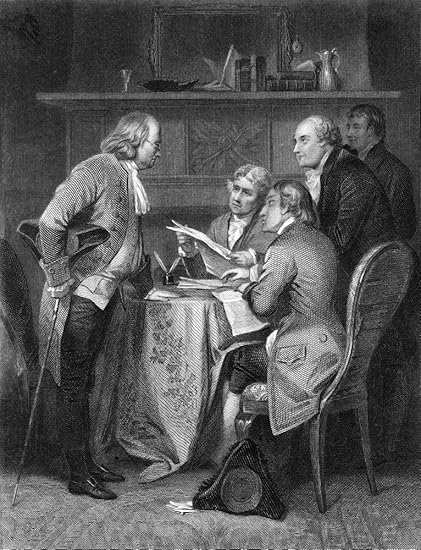
The committee was chaired by Thomas Jefferson. Its four other members were John Adams and Benjamin Franklin (each of whom was counted
twice for the sake of Stature - ok, ok, Roger Sherman and Robert Livingston were also on the committee.)
The Declaration of Independence wasn't a very long document, but little Tommy Jefferson was trying so hard to impress all the older guys that he
overwrote it, using an archaic style of English that is best understood in translation.
Here is a translation of the Declaration in its entirety:
"It's a good idea to let people know why you're having a revolution. We think it's pretty obvious that any government that screws its people over is
cruising for a bruising. We're not saying anyone with a hair up their butt ought to have their own revolution, but we've put up with an awful lot of
crap from King George. He won't let us do anything on our own, and whenever we try, he sends people to kill us. We've asked him over and over
to back off. We've told him over and over that we'd only put up with so much. But did he listen? No. So to hell with him and to hell with Britain
and all their phony goddam accents. We'll kick their ass or die trying."
These were, what political scientists refer to as "fightin' words."
On July 4, 1776, the Declaration was presented to the Congress. Nine of the thirteen colonies voted to adopt it. Pennsylvania and South Carolina
voted against it (we know where you live). Delaware couldn't make up its mind, and New York abstained. Copies of the Declaration were
distributed the next day (photocopiers were much slower back then). On July 8 it was read aloud in Philadelphia's Independence Square.
The document wasn't fully signed until August, but as soon as it was, Americans began shooting the British in earnest. By February of 1783 they
had shot enough of them that Spain, Sweden, Denmark and Russia officially acknowledged the United States of America as an independent nation.
In honor of our Independence, we celebrate the anniversary of its declaration by blowing things up, roasting dead animals over hot coals or
gaseous flames, and drinking cold, sudsy beverages that inhibit our ability to think. Such festivities may not honor the philosophical nuances of our
revolution, but they do keep the rest of the world at a comfortable distance.
Happy Fourth of July folks!!!
And bunkies remember - Drink til you drop and don't drive! The live you save may be mine.
Despite what the man in the White House thinks about his former bro, Justin Trudeau, the ACME Eagle Hand Soap Radio Hour would like to salute our friends in Canada on Canada Day.
Canada is the second-largest nation in the world. It is not part of the United States - (it's the U.S.' nicer sister, not dissing Mexico, the U.S.' feistier sister.)
A little jewel sitting at the top of the continent.
In the 152 years of their nationhood, Canadians have given the world paint rollers, snowmobiles, electric organs, green ink, toboggans, snow blowers, plexiglass, and the push-up bra.
Canada has about the same population as California, but fewer Scientologists.
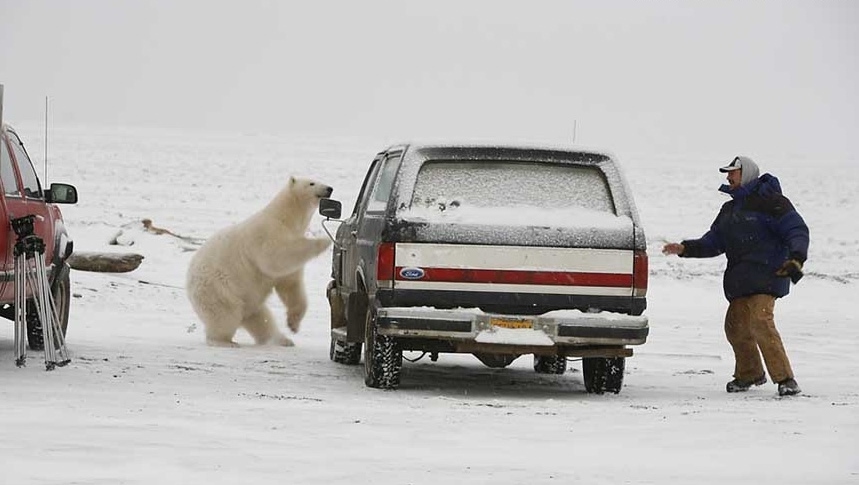
Residents of Churchill, Canada, leave their cars unlocked to offer an escape for pedestrians who might encounter Polar Bears.
Today is the 39th anniversary of the Canadian national anthem, 'Like America, But Colder.'
Canada's leading export to the United States is Canadians. Dan Aykroyd, who happens to have been born exactly 67 years ago today, is one.
Pamela Anderson is another, and was also born today, although she's younger (most of her is north of 40, but some parts are significantly younger).
Other Canadian exports: Bryan Adams, Paul Anka, Alexander Graham Bell, Raymond Burr (of nipple rouge fame), John Candy, Jim Carrey, Celine Dion, Michael J. Fox, John Kenneth Galbraith, Lorne Greene, Peter Jennings, kd lang, Marshall McLuhan, Joni Mitchell (hopefully she's doing well), Alice Munro, Mike Myers,
Catherine OHara, Oscar Peterson, William Shatner, Alex Trebek, Shania Twain, Neil Young and of course everyone's favorite Canadian Zen Buddhist, the late Leonard Cohen.
(... I don’t mean to suggest that I loved you the best, I can’t keep track of each fallen robin.)




/https://www.thestar.com/content/dam/thestar/sports/hockey/2011/01/11/kelly_canadian_world_junior_fans_criticized_in_buffalo/fans1.jpeg)